<<< 108 – Remembrance & Advent 2023>>> 106 – Christmas 2022
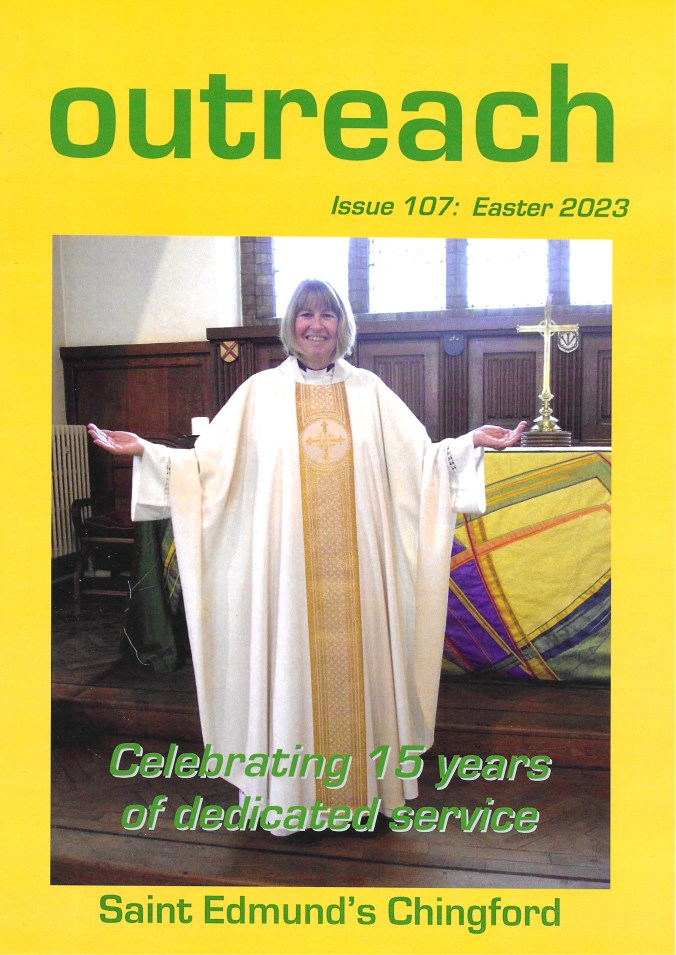
A selection of articles from our parish magazine
Issue No 107 Easter 2023
Vicar’s Letter
Farewell Lesley
Memories of Lesley
27 Years a Churchwarden
The Day Between
Easter Chicks
Easter Celebrations in Ukraine
Easter – A Moveable Feast
Make Yourself an Easter Chick
Obituaries
St Edmund’s Animal Food Bank
Vicar’s Letter
The clocks change on Sunday 26 March this year and, as we gain that extra hour, the days open up and Spring really feels as if it has sprung!
This is a season of hope and new beginnings after the dark and cold winter months, as we listen to birds calling and see the new growth in our gardens and flower tubs. In to all of this comes Easter, a time of light, yet also darkness before that light, that darkness before dawn, which can be so deep and intense.
Each year as Christians we go through this cycle of joy and praise on Palm Sunday, the hopes of Holy Week and the depths of despair on Good Friday, which meteorologically is often a beautiful sunny day! One of the special moments for me on Good Friday is to stand in the empty church contemplating the starkness with all the cloths and furnishings removed from the altars; laid bare, just as Jesus was left alone as all, except a very few deserted him.
At times in our lives, we too may feel that sense of emptiness and despair when hope seems a very long way away. With concerns about the cost of living, conflict in the world and the constant negativity we are bombarded with, it can feel that there is no hope. Yet hope is always there because God is always there, even when we can’t feel that presence. God is there, yesterday, today and tomorrow, waiting for us to turn to God and say “Here I am.”
The final station in the Stations of the Cross here at St Edmund’s is the body laid in the tomb. It is a scene of peace. At first glance it is the end, of failure, but around the edges of the stone across the entrance is the light of the new dawn, the light of new hope and new beginnings. Good Friday was not, is not, the end. At Christmas we celebrate that the light was coming into the world but recall that the world did not know that light. At Easter we see that the light, the Christ overcomes the darkness.
Spring and Easter are indeed a time to look forward with hope and anticipation, to look towards the light and God’s presence.
This will be my last Pastoral Letter as I am retiring at the end of April. It has been a real privilege to minister here in South Chingford, and I wish you both a happy and blessed Easter and hope and joy in your own journey with God.
Lesley Goldsmith
Farewell Lesley
Lesley Goldsmith arrived at St Edmund’s in 2008, following a Curacy in East Ham, and came with much promise with real world experience as a later-in-life Ordinand: she previously worked in Local Authority housing management before her ordination as a Priest in 2006. Though ordination had been open to women since 1994, and St Edmund’s had expressly said it would accept a woman in post, even when Lesley was appointed as its first female Vicar in 2008, some felt uncomfortable with women as Priests. However, on meeting Lesley, those with worries were reassured. Lesley threw herself into creating a Church where all (whatever their opinion or tradition) felt at home and included. Vocations have been important to Lesley, and she opened up lay participation at St Edmund’s: inviting many to assist in the distribution of communion. During her incumbency more laity have been encouraged to read, lead intercessions and preach than at any other time here at St Edmund’s. She recommended Colin & Dee to train as Local Preachers; and encouraged ideas from Pauline and Cheryl for new initiatives that came to fruition in our Bereavement Support Group and Little Edmundos. The Diocese quickly saw that in Lesley it had someone who could be trusted to train those new to ministry, and during her time here the Parish received three Curates – James Monger, Sara Batts and James Gilder – to be mentored by her, as well as five others who came to St Edmund’s on placement. She was an effective safe pair of hands within the Diocese, and raised our Parish’s profile. Lesley has nurtured strong community relations, particularly through the local schools and at Park View care home, and served as a Governor at Chase Lane. She has worked with other denominations to campaign on local issues (including against the closure of South Chingford Library), while continuing to support and work with New Road Methodist Church in covenant. She also embraced when the Transforming Presence initiative, liaising with the Clergy of St Andrew’s Walthamstow and St Anne’s Chingford to establish our Mission and Ministry Unit, becoming its first Unit Leader. Lesley brought her love of Taizé music to liturgy, especially prominent during the Eucharistic prayer at the All Age Worship service. Most recently, Lesley led us through the uncertainties of the Coronavirus Pandemic, rising to the challenges it brought and ministering to the fears and difficulties it instilled. She has always been a tireless worker for St Edmund’s, making sure everything is considered, organised and effectively achieved. She is a well loved and respected Vicar, and the success of her 15 year incumbency is down to the skills she has used to take our Church and Parish forward. As Lesley leaves us, we are grateful for what she has done in South Chingford to prepare us for a bright future, bringing innovative ideas to our liturgy, mission and ministry. We wish her well for the future.
Memories of Lesley
On 24 February 2008, the Archdeacon of West Ham (Elwin Cockett) announced during the 10am service here the name of the new Vicar designate. It would be exactly four months later, when the wider congregation of St Edmund’s first met Lesley when she was collated and inducted as our Vicar on 24 June. That wasn’t however the first time I met Lesley. Back in October 2007, the PCC appointed Dee Gürfer and me as Parish Representatives during the process of filling the vacancy following Christopher Owen’s retirement as Vicar. And so on 30 January, the Bishop of Barking (David Hawkins), the Area Dean (Steven Saxby), Dee and I, first met the three prospective candidates – one of whom was the Assistant Curate at East Ham, one certain Lesley Goldsmith. Not only did we put the candidates through the expected interview but we had decided to shake things up a little by giving them a tour, meeting a small hand-picked selection of Church members and community representatives for a lunch of soup, bread and cheese, but we also asked them to give a little “sermonette” or reflection on one of the readings of the day. Assuming everyone would plump for the relatively more-straightforward passage from Matthew of Jesus in the Garden of Gethsemane, I had joked to the Bishop beforehand that anyone with the courage to take on Genesis 14’s Battle of the Nine Kings perhaps should simply be given the job without further consideration! It was a bit of a surprise when one candidate actually rose to that challenge, but it was obvious another candidate stood head and shoulders over the other two and came across strongly at interview and gave a considered reflection of the Gethsemane scene. And so, Lesley was selected as the right person for our Parish (and not simply because she appreciated my selection of Barkham Blue cheese at the lunch). In my final year as Deanery Lay Chair, at her induction service that June, in the procession at the start of the service it was me who walked beside her up to our seats in the Chancel, and as I did I knew it was a job well done, and that in Lesley we had a Vicar who would lead us forward as a Church, community and family.
Colin Setchfield
I will like to give thanks to Lesley for being there from the day of my wedding and all through my immigration status up to my citizenship. Even after I moved out of the borough, she was still there for me. I must confess she’s a mother to the motherless and with great personality. As she retires, may the Lord keep her well and may her days be longer than her forefathers, so she may enjoy all the good things life has to offer.
Charles Okojie
We were honoured to be Lesley’s very first wedding as soon as she joined (August 2008)! She was so helpful from start to finish, and did a wonderful job on the day. All of our guests commented on how lovely she was. We have continued to enjoy Lesley’s friendship ever since our wedding and, when our precious Emma came along, we enjoyed Emma going to Little Edmundos / activity weeks / Brownies / Guides etc, plus of course all the Christmas fayres / quiz nights / beetle drives / summer parties etc. Lesley would always pop over if she heard someone was ill in the family, to offer her support and see how we were. We wish her well in her next venture, but we will all really miss her!
Lisa, Bjarte & Emma Valen & Jean & Roy Nash
A year after Lesley joined us, out of the blue, a lady, who had been recently bereaved, phoned asking if St Edmund’s had a support group. I told her unfortunately we didn’t but I said I felt sure Lesley would be able to help. I asked Lesley if she knew of a group that we could suggest to the lady. Lesley did have a suggestion but not what I was expecting. She asked me if I would like to start a bereavement support group here. I must admit it took me by surprise, but I took on the challenge, and the group started in Autumn 2009 with initially 2 bereaved people joining. It is now a thriving group of 22.
Pauline Setchfield
Lesley has been there for us during some key moments in our lives. Giving the last rites and funeral services of both my mum and dad, along with David’s dad’s funeral. She married us in 2010, and was instrumental in our baptisms in 2013. She also got us through the pandemic with our virtual services and get togethers in our own homes. We will miss having Lesley supporting us.
Jackie Brock
Reverend Lesley has played a major role in my introduction in to my most significant period of Christianity. She has, without fail, been understanding and welcoming. In addition, Reverend Lesley has been the guiding religious figure in many of the most significant ceremonies of my life. She will be greatly missed in and around South Chingford.
David Brock
My first memory of Lesley is fifteen years ago when I was at a Church fayre with my mum. Lesley had just joined St Edmund’s as Minister. She came over to our table and introduced herself. We chatted for a while over a cup of tea before she met and greeted others at the fayre. Lesley has been an inspiration over the years and will be missed by all who know her.
Carole Rogers
I will always remember Lesley as the Vicar who turned St Edmund’s round, creating a Church at peace with itself, respecting the differences of its members, and working to find ways of keeping people happy. Lesley’s skill has been in engaging with all, regardless of where they come from, and making them feel included. Lesley has been a fantastic Vicar and I will miss her.
Andrew Setchfield
I got to know Lesley approximately five years ago. It was a blessing to me and my family to have met such a warm and loving person, and we were immediately welcomed in to the Church family. It was great to be with Lesley, worshiping God and taking part in Church activities, including visiting other Churches for worship, although we had to miss out during Covid 19 and health challenges in the past few months. We wish Lesley all the best and God’s blessings during her retirement, and thank her for embracing our family into the arms of St Edmund’s Church family where we are happy to worship with everyone.
Leroy Charles
Lesley’s Induction was on 24 June 2008, the same day as my birthday, so my birthday celebrations were put on hold –the same as the previous year when Christopher Owens left! I also remember that Lesley dressed up as a hippy (with a ’60s style wig and kaftan) for my 60th birthday celebrations. Well done Lesley.
Christine Setchfield
I remember Lesley’s Induction in 2008. The Bishop at the time was David Hawkins. He was always one for bringing props along for the sermon, and likened Lesley to Little Bo Peep with a straw hat and shepherd’s staff. Lesley also helped me through my confirmation preparation, seeing me after work.
Claire Halls
When Lesley first came to St Edmund’s, I was a church member but was still working so did not have time to help at Junior Church. Sunday was my day without children. When I retired from teaching I started helping out both at Junior Church and Little Edmundos. Throughout the rest of my retirement, Lesley has encouraged me in my ministry with children , helping with the summer activity week and thus enabling it to go ahead. It was Lesley that asked me to become involved in the food bank. She has certainly had a big impact on my life and changed the direction in which I thought I was heading. It may be God’s Will but He used Lesley as the instrument to show me the way. Lesley has always been there for me and I will miss her greatly as will we all.
Debbie Watson
Thank you for the work you have done at St Edmund’s. We are also grateful for the support you have given our family in times of need. May God guide your future endeavours.
Ellie Mwaramba & Family
Thank you Lesley for making me very welcome from the first moment I stepped in to the Church. You, the Church and congregation, helped me through a very dark time in my life. Having come from a religious background, St Edmund’s was the first Church I felt comfortable and accepted in, so much so I became Church of England. You were kind and came to visit me when I was unable to attend Church and gave me communion. I’ve enjoyed all the Sundays serving with you at the altar. My family will miss the chutney at Christmas. You will be sorely missed, but all the best for a happy retirement, enjoy your rest, you deserve it. Thank you and God bless.
Patrick Archer
Rev. Lesley is a life force! It will be very hard to replace such a remarkable lady. She always does everything with all she’s got. I first came to St Edmund’s after my beloved husband ’Gwyn passed away. I was recommended to the bereavement group as I was struggling with grief. I arrived and it was pouring with rain. I did not know where the group was held. I was standing outside the Church, so I called Rev. Lesley on my mobile. I stood there and she appeared from nowhere. She had her heavy duty coat on and looked like a monk. She led me in to the Church and there I met Pauline, who runs the group. It was the turning point. I have attended the group for 13 years now because I like the camaraderie and compassion. With her help, and of course Pauline and the group, she guided me back to some sort of normality and I’ve attended the Church and got confirmed, which is a great meaningful reality for me. I wish her well for the future and thank her for being there. As my late husband, who was in the Royal Navy before being a Police Officer would say: “Steady as you go!”
Pam Wigley
Lesley, I appreciate all the support you gave to my parents when they were here. My mother, in particular, always looked forward to your visits especially when she wasn’t able to attend Church towards the end. Thank you for all you’ve done here at St Edmund’s and from all my family we pray that your new chapter in life will be happy and blessed.
Catherine Greenidge
27 Years a Churchwarden
If anyone had told me at the beginning of 1996 that by the end of the year I would be a Churchwarden, I would have laughed in their face. I had been on the PCC twenty-odd years and was a Sunday School Leader, which I thoroughly enjoyed. Being Churchwarden had never entered my mind. However, towards the end of that year things changed.
One of the Churchwardens decided he couldn’t continue with his duties and an emergency meeting had to be convened. At that meeting, after nobody would agree to have their name put forward, the then Vicar became desperate. He came over to me, sat down next to me in the pew and pleaded with me to take on the task. I must admit I was dumbstruck as I would never have put myself forward for that position. However, seeing his desperation, I agreed, not knowing if I had taken the right decision. I decided that if I was going to do the job to my best ability, I should give up being a Sunday School Leader. This I did and other capable folk stepped in to take over.
The first year as Warden was a learning curve for me and there were many issues for Tracy, the other Warden, and me to deal with. The following year, Tracy decided she wouldn’t continue as Warden and she resigned. During my time, I have served with five Wardens, Tracy Lea, Reg Bennett, Fred (my husband), Ken Smith and currently Debbie Watson.
Being a Churchwarden has stretched and challenged me, which is a good thing, as I am really quite shy and find small talk difficult. During my time in this role, I have tried to make everyone who enters our Church building welcome and I hope I have been supportive and shown love to those of our Church family when needed. Over the years, God has shown me my capabilities. It is not being the perfect Churchwarden, but doing the job to my best ability.
Since I fell and broke my hip in 2018, I have been very limited in the way I have been able to carry out my duties as Churchwarden and, therefore, I feel it is time for me to step aside and enable someone else to take the reins. I really shall miss it, but now is the time for change.
Pauline Setchfield
The Day Between
The Good Friday story concludes with the body of Christ hastily being removed from the cross, rushing against time, before sunset ushered in the start of the Sabbath day of rest. Though crucifixion could be a slow, long and painful death, lasting days on end, his death was relatively quick. Likely as a result of the scourging and maiming meted out before his execution, and of the haemorrhage and dehydration as he hanged, the shock and pain to his body combined as he progressively asphyxiated – unable to last out not even the whole day. The grisly recorded detail of the Roman guard precipitating the demise of other victims by fracturing their leg bones was not his fate, though the spear stab wound to the heart was another means at their disposal. The final scene of that Friday is of his dead body hurriedly being placed in a borrowed tomb before the darkness of night came.
It is finished! blessèd Jesus,
thou hast breathed thy latest sigh,
teaching us the sons of Adam
how the Son of God can die.
Lifeless lies the piercèd body,
resting in its rocky bed;
thou hast left the Cross of anguish
for the mansions of the dead.1
The Saturday of Holy Week – Easter Even – feels like a rather-neglected day of the Paschal Triduum (or the three ‘still days’ – as the Anglo-Saxons called them), which precede the Great church festival of Easter on the Sunday. Having left Jesus in the tomb at the end of the service on Good Friday (and despite liturgical provisions and specific hymns for the Saturday), the church on the whole takes that Old English epithet (‘still’) to heart and allows the story to remain stationary, while it busily makes preparations for the ‘big event’ on the Sunday: readying its churches or even pre-empting the celebration a bit, in the evening vigil at the end of the day.
But what do we lose in seeking to rush from Good Friday to Easter Sunday? What if we take that “day between” Good Friday and Easter – that “day between” crucifixion and resurrection – seriously? What if we confront that day when Christ is not dying nor risen but lies dead? On such a day which, in the words of the German theologian Bonhoeffer, we go to God but only to “see him engulfed in sin, weakness and death.” The previous Pope – Benedict XVI (himself born on the day before Easter in 1927) – reflected in his memoirs that our lives are one long Holy Saturday, waiting for Easter: “not yet standing in the full light but walking toward it full of trust.”
Late at even there was seen
watching long the Magdalene;
early, ere the break of day,
sorrowful she took her way
to the holy garden glade,
where her buried Lord was laid.
Myrrh and spices will I bring,
true affection’s offering;
close the door from sight and sound
of the busy world around;
and in patient watch remain
till my Lord appear again.2
We speak of Easter as the Day of Christ’s Resurrection, except that in the pages of the Bible there is a distinct lack of a Resurrection story as such; the Resurrection event is never described. Instead on the Sunday morning (the first day of the week), we have stories of an empty tomb and of appearances of the risen Christ, that are signs of the Resurrection and the basis of the early church’s faith in and proclamation of its reality.
The Resurrection, rather than coming with a fanfare of trumpets and a glorious heavenly light, comes out of the dark ‘inbetween day’ during which Christ lay dead and lifeless in a grave: a sabbath marking a life-giving God at rest, inactively non-creating. As the American priest and author Barbara Brown Taylor expressed it: the Resurrection “happened in the dark, with the smell of damp stone and dug earth in the air.”
By Jesus’ grave on either hand,
while night is brooding o’er the land,
the sad and silent mourners stand.
Deep in the rock’s sepulchral shade
the Lord, by whom the worlds were made,
the Saviour of mankind, is laid.3
This “day between” speaks of the realities of being human: the unknown-ness that follows loss; when we need to let go of what we had or understood and wait not knowing what will come or what will be; when overwhelmed with pain or grief, future joy and hope remain uncertain. The Saturday when Christ lies dead is a ‘liminal’ space, neither Good Friday nor Easter Day, but like so much of our lives it is a place of transition, a border-land where we linger for a while. Easter has still yet to come. We need to hold back in our rush to push forward, to flee the reality in which we find ourselves, in order to lay hold on some ‘happy ever after’ that we hope tomorrow might bring. Instead, we are asked on this ‘still day’ to be still ourselves, and to hold what is past and what is to come, what was and what will be, death and life – in tension together.
It is this day, in its quietness and unanswered questions, in its loneliness and despair, when we may catch sight of our own lives mirrored in its telling. Unsettled, the natural inclination is to run, to flee to Easter, to find that foreboding tomb empty and exposed, to catch glimpses again of what was – even if in new and unaccustomed ways. That comes. But we have to live in the now, even when our human experience is uncomfortable and painful, and when answers to unresolved questions are uneasy.
As we wait in the day after Good Friday, in its disorientating silence and resting inaction, in its space carved out in the betrayals, abandonments, and dyings of yesterday, it is in those uncomfortable hours where we might (to quote the poet Wendell Berry) “practise Resurrection.” For it is then – in that ‘non happening’ – the Resurrection occurs, unobserved and missed; Easter allows us lately to catch up and simply to see the signs of and experience what already is and has been. It is then, despite all, that we see that the day we sought to avoid, that we allowed to pass, is itself a Holy Saturday.
When Christ lay dead the widowed world
wore willow green for hope undone:
till, when bright Easter dews impearled
the chilly burial earth,
all north and south, all east and west,
flushed rosy in the arising sun:
Hope laughed, and Faith resumed her rest,
and Love remembered mirth.4
Colin Setchfield
Extracts from Easter Even Hymns
1 It is finished blessèd Jesus, by William Dalrymple MacLagan 1826-1910 Return to article
2 Resting from his work today, by Thomas Whytehead 1815-1843 Return to article
3 By Jesus’ grave on either hand, Isaac Gregory Smith 1826-1920 Return to article
4 Our Church palms are budding willow twigs, by Christina Rossetti 1830-1894
Easter Chicks
It was about twenty years ago that I first came across the knitted chick. My sons received one each on Easter Sunday and were both intrigued and impressed to find that their chick laid an egg, a chocolate one at that!
The gift of a knitted chick, complete with chocolate egg, has been part of Easter at St Edmund’s for as long as I can remember. They were introduced by the late Margaret Hinds, a wonderful member of the congregation who could turn her hand to all manner of crafts.
Over the years, Margaret’s health declined and she was unable to produce them. In the meantime, I had shown these chicks to my Mum (who was also amazing at anything craft related) and she was able to unpick and work out the pattern. Being an enthusiastic, if not particularly talented knitter, I was able to follow the pattern and, after a few false starts, the new generation of knitted chicks was born.
Over the years, my speed has improved and the chicks are distributed not only at St Edmund’s, but also at Chase Lane Nursery and the Food Bank. The tradition continues to evolve as, last year, I introduced a more colourful range of chicks which brightened Easter Sunday even further.
Thanks to Margaret’s skill and kindness, hundreds of children (and adults!) continue to receive a simple knitted chick and chocolate egg.
For those who wish to give it a go, here’s the pattern:
- Cast on 20 stitches.
- Knit 4 rows.
- Increase an extra stitch at the end of each row for the next 8 rows (36 stitches).
- Knit 4 rows.
- Cast off 12 stitches at the start of the next two rows (12 stitches).
- Knit 12 rows.
- Knit 2 together over the next two rows (3 stitches).
- Knit 1, knit 2 together.
- Knit 2 together.
- Cast off final stitch.
To make up:
- Using black cotton, sew two eyes (I make a large cross).
- Cut a diamond shape from orange felt, fold in half and sew just below the eyes.
- Folding the chick in half (right sides inwards), sew along the seams but leave the bottom open for the egg!
- Stuff the head and tail of the chick with toy stuffing or cotton wool.
- Add a chocolate egg of your choice!
Julie Field
Easter Celebrations in Ukraine
Easter day is known as ‘the great day’and is determined according to the Julian calendar. It is a mixture of traditional Christian practices and ancient pagan rites. Midnight Mass starts at 9 p.m. with psalms and hymns, and often continues well after midnight. Worshippers arrive in Church carrying their traditional Easter baskets filled with various foods, the most important of which is ”paska” (Easter sweet bread) flavoured with ginger, vanilla and rum, and is richly decorated. The basket also contains salt, butter, cheese, and coloured eggs. A bottle of sweet wine, similar to that used for communion, is often included. The baskets are blessed by the Priest who sprinkles them with holy water.
On the way home from Church, people greet each other with “Christ has risen”and “Have a blessed Easter”. They hold decorated candles which have been lit in Church.
The breaking of the fast starts with a hard-boiled egg sprinkled with salt, a crust of bread, and a sip of water. As for the Easter meal, it consists mainly of ham or lamb, kolbasa (spiced sausage), twarog (soft cheese), and grated horseradish – symbolising Christ’s suffering on the cross. Eggs play an important role in Ukrainian tradition: they can be decorated with stickers in ethnic designs, hand painted, or simply coloured using natural dyes and beeswax. Friends and neighbours exchange eggs. During and after the meal, sweet red wine and, of course, vodka are consumed, along with cakes and nuts.
Eleonora Maslennikova-Glover
Easter – A Moveable Feast
In the New Year a friend of mine, who is an avid Church-goer at a ‘High Church,’ asked me which day is Easter Sunday this year. I didn’t know off hand, so Googled the date on my smart phone. When I told him the date, I asked why he wanted to know the date now. He said, “It will determine my movements for the first few months of the year. Knowing when Easter is – being a moveable feast – I know when Ash Wednesday, Lent, Mothering Sunday, Holy Week, Ascension Day and Corpus Christi are.” Then after that, he can arrange appointments, concerts and other non-Church activities around the Church Calendar.
Over the Easter period I would never see him unless I went to his Church, with him, which I have done on the odd occasion. On Holy Week he would go to all the daily services. At Maundy Thursday’s service the highlight was the Washing of Feet. In case he was one of the twelve who was picked, he would wash his feet at home before setting out to the service, because he didn’t want the embarrassment of the Vicar having to deal with his cheesy feet.
Come Good Friday, there was a Church service in the morning and the Stations of the Cross in the afternoon. Then on Saturday afternoon there was a rehearsal of the Easter Vigil, and that service (in the evening) would go on to Midnight. On Easter Sunday there was a morning service, followed up later in the day by Evensong & Benediction. I wouldn’t see my friend on Monday, because he was resting after a hard week of worshipping.
As Easter is a moveable feast I remember, a few years back, that Easter was the earliest it could be. It was said that it would not be that early again for another 130 years – so I don’t think I’ll be a round to see it. As it was March, it was the weekend that the clocks went forward. The weather was awful: it was cold, with large amounts of rain and sleet. Schools had the two Easter Bank Holidays off and went back the day after Easter Monday for two weeks, the broke up for the Easter Holidays in April!
As Easter was early, there were some parts of the media saying that Easter should have a set date, like Christmas. Another year Easter was late April, which was a total contrast to that earlier Easter. It was nice sunny warm weather, with people sitting relaxing in the garden wearing shorts, picnicking in the park or going to the coast. However, regardless of when Easter falls in the calendar, the Easter message is always the same. The season coincides with warmer Spring weather, beautiful flowers, and a renewal of life and joy; celebrating the Easter miracle of Christ raised from the dead, giving us hope for life after death.
John White
Make Yourself an Easter Chick
It is now Spring when baby birds are hatching everywhere. To make yourself an Easter Check, you will need a wooden clothes peg, some scraps of card and glue (glue stick is fine).
Draw a small egg on a scrap of card and decorate as you like. Cut across the middle in a zig zag to look like an egg that has cracked. Stick on to the peg so when closed the pieces meet together but when you open the peg the parts move apart. Cut a small chick and decorate. Stick the chick to the back of the peg so that you can see its face when you open the peg.
Debbie Watson
Obituaries
Colin Adams
Born, 16 September 1933. Died, 23 November 2022.
Although christened at St Edmund’s in 1933, Colin Adams was brought up at the South Chingford Salvation Army Citadel in Chingford Mount Road, before returning to St Edmund’s after the war in 1945. As a 12 year old boy, he joined Trevor Gartside’s Sunday School class when Mr Thomas was the Superintendant. Then, when Mr Miller arrived at St Edmund’s, Colin was one the new Vicar’s first Confirmation candidates, and was confirmed by the Bishop of Barking. At that time he joined the Youth Fellowship and, in 1954, took a role in representing St Edmund’s at a big Youth Fellowship rally at West Ham Football Club, celebrating the 1300th anniversary of St Cedd. In 1958, Colin married Vivien, who had recently joinedStEdmund’s, and went on to adopt two children – Stuart and Lorna. Colin was a member of the Parochial Church Council from 1958 and Churchwarden from 1966 until he left in 1973. He was a tireless worker at St Edmund’s: teacher in the Sunday School when Harold Roberts was Superintendent; representing St Edmund’s on the Ruri-Decanal Conference; and running the stamp stall, selling both British and foreign stamps, at the annual Christmas Bazaar and missionary events. Initially, Colin and Vivien moved to Reading when his work moved out of London, before retiring in Blackpool. As a passionate aficionado of trams (and indeed all forms of transport) this was an idea location for his twilight years, as the town boasted one of the world’s oldest tram networks. He would occasionally visit his old Church, joined the Friends of St Edmund’s in 1985 and remained a member until it folded 30 years later, and always kept in touch with the people he knew here. As a person who meticulously recorded things, he was a valuable source of information when writing St Edmund’s history. He was a kind and gentle man with quirky traits, who was always there when needed; and although he was sometimes misunderstood, he had a heart of gold.
Beth Carter
Born, 5 November 1923. Died, 8 January 2023.
Beth Carter found her faith while a member of the 14th Westminster Guides. Although her father and much of her family were Roman Catholic, her mother was Anglican and brought her up in the Church of England at St Barnabas Pimlico – a Anglo Catholic Church with a tradition she held true to throughout her life. In 1971, Beth moved to Chingford with her husband Terry, and joined St Edmund’s. When Sidney Wood arrived as the new Vicar, he made significant changes to the Sunday School and, as it transformed in to the Sunday Club, his wife Jean took over its leadership and new teachers were appointed to take forward a new approach. One of those teachers was Beth. The Sunday Club was re-branded as St Edmund’s Junior Church (under the leadership of Deaconess Turner) when Eric Ford became Vicar, and Beth – always referred to as Aunty Betty – remained an integral part of it, at one point taking a class of over 30 children. She also formed a prayer group with the Deaconess and Hilda Deal to regularly read Compline. Beth had a love of children. With Terry, she ran the Toy Stall at the Christmas Bazaars. They would always decorate one of the plain windows in Church at Christmas for the children; and Beth would create little posies of daffodils for the children to take to their mums on Mothering Sunday. Her grandchildren were very special to her: Tracy and Claire Syme would visit her on Sundays and accompany her to Church; and Beth was very proud when they joined the choir during Katherine Rundle’s time as director. They followed in her footsteps, as Beth had assisted the choir on an ad hoc basis since 1984. As the Church changed during the 1990s, Beth felt that it no longer really expressed the faith she grew up with. She was never happy with the ordination of Women but her love of St Edmund’s was stronger than the innovations, and she willing accepted Lesley Golsmith as her new Vicar in 2008. Terry died in 2012, but Beth remained in Chingford a few years longer, until she moved in to Sheltered Accommodation in North Weald in 2015 to be closer to her daughter Mary. Later she entered a care home in Theydon Bois, where she lived out her life to the grand age of 99.
STOP PRESS: It is with great sadness that we learnt that Gerald Goddard had passed away on Thursday 16 February. Gerald was a member of our 8 a.m. Sunday congregation, travelling from North Chingford to attend our 1662 Communion service, prior to mobility issues confining him to his home. He loved the language and services of the Book of Common Prayer.
St Edmund’s Animal Food Bank
No owner should have to pick between feeding themselves or their pet. People should not be forced to give up their pet because they have fallen on hard times. Many food banks do not offer animal food and so, those referred to food banks, often still have to make the decision about how they manage the little money they have between rent or mortgage payments, fuel costs and their pet’s food and care. The love and companionship that pets provide can make difficult situations better; for some, who live on their own, it is the only friendship they have. By providing people with free pet food, that is a pressure taken away from them, and it can very likely save a pet from the risk of being put down or re-homed simply because the economic climate has changed. That is why St Edmund’s runs an animal food bank. Our local food bank does sterling work providing food to people who have fallen on hard times, but it does not cater for animals. Therefore, those who are referred to it who have animals are then also referred to St Edmund’s for pet food. But keeping stocks sufficient is a challenging task. If you are able to help by giving pet food for our animal food bank, it will ensure local pet owners are able to continue feeding their animals without fear of reducing what they have for other life essentials. Wet dog and cat food are always in demand, but anything you can give would be gratefully received. Items can be dropped off at St Edmund’s Church (in Larkswood Road) on Saturday mornings between 10 and 11 a.m.
© 2023 St Edmund, Chingford
 St Edmund, Chingford