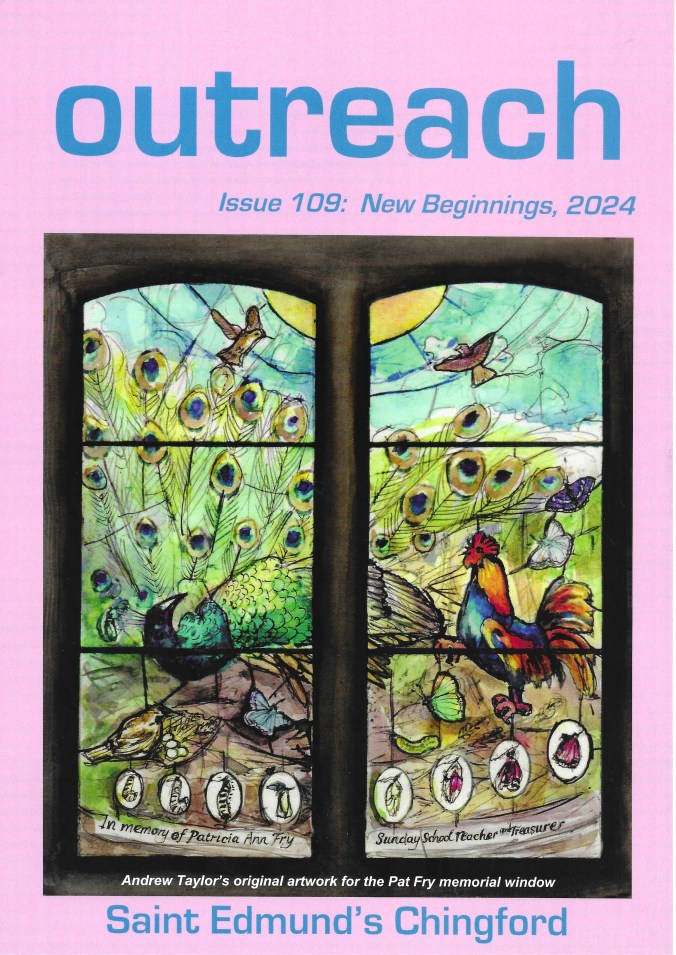
A selection of articles from our parish magazine
Issue No 109 New Beginnings 2024
Introduction
Pastoral Letter
New Beginnings
What’s New?
Here’s To New Beginnings
30 Years Of The Ordination Of Women As Priests
For All The Saints
Obituaries
Introduction
Hello! My name is Ruth, and I am delighted to introduce myself to you as the next Vicar of St Edmund’s. I write from Ely in Cambridgeshire, where I am currently a Curate. Before ordination I mostly worked for the NHS, firstly supporting a patient support project with Macmillan Cancer Care and then helping to co-ordinate research, with a particular interest in mental health. Alongside that, I began to serve and lead a Church youth group which slowly grew into a desire to minister to people of all ages, and eventually a call to ordination. I trained in Oxford, taking a Masters in practical theology drawing on some of my NHS interests to think about how we pray for and care for those with long-term illnesses. I enjoy having a busy life –hosting friends, getting out on my bike, travelling, and making the most of whatever is on at the theatre and seeing live music. I am looking forward to being that bit closer to central London for the latter!
It is an exciting time in the life of St Edmund’s Church and the Parish. I am very thankful to all those who have invested themselves into ministry and mission during the past year. It is a real encouragement to be arriving somewhere which has not only survived a time of vacancy but has looked expectantly towards the future in a way that allows for growth and change. I look forward to working with all of you as we partner together in living out the gospel, through our worship and our work in the Parish.
It has been a long wait, and there is yet another pause as all of the arrangements are made for my collation (which will mark the start of my ministry in the Parish). Until then, please do join me in praying that our eyes will be open to God at work both in this time of transition and in the years ahead.
Ruth Holmes
Pastoral Letter
Last month, on 19 May, we celebrated Pentecost. This was when the disciples gathered together in a room, and suddenly heard a sound like a strong wind which filled the room and resulted in tongues of fire resting on each of their heads. This affirmed John the Baptist’s message that Jesus would baptise with the Holy Spirit and Fire. The disciples then began to speak in different languages, and Peter said it was a fulfilment of God’s promise of the renewal of all flesh by the Spirit.
That same Spirit empowers us today. We know that if we trust in God “joy will come in the morning”. Indeed, that joy has come to St Edmund’s in a time of new hope, new life and new beginnings. We are overjoyed that Ruth Holmes has been appointed as our new Vicar.
Over the last 14 months we have risen to the challenge of keeping St Edmund’s fit and ready for our new Vicar. All this has been possible because of all who have regularly attended and supported the Church during this time, with the leadership given by our Churchwardens (Andrew and Catherine) and all those who have ensured our services are covered, and the small and dedicated band of people who regularly prepare the Church for services every Saturday. Attendance has stayed fairly stable which makes everything encouraging.
We now look forward to a new chapter in the life of St Edmund’s with Ruth’s induction on the 1st July.
Pauline Setchfield
(Pastoral Assistant)
New Beginnings
And so our time of waiting draws to a close as we prepare to welcome Ruth Holmes as our new Vicar on 1 July. With fewer clergy to call upon at the beginning of the year, covering services proved more challenging. We are grateful to all those who continue to support us, but particular mention must go to Maria Holmden and Mick Scotchmer, who have taken on the lion’s share, and to Lynne Cullens (our Area Bishop), for stepping in not only to take our Christmas morning service but also both services on Easter Day as well–it would have been impossible for us to celebrate with Communion on these key festivals without her generosity. We are also indebted to Stella Olukanmi for the pastoral care she extended to Patrick Archer during the last months of his life. We have good friends, both within our Mission and Ministry Unit (MMU), and beyond.
Last year brought change and new faces more widely in the Church as well. Elwyn Cockett, our Archdeacon, faced health issues but we are happy that he is now back with us. Vanessa Conant, our Area Dean whose help and guidance during the interregnum and the appointment process was invaluable, is celebrating a new family and Sue Lucas has been appointed as our new Area Dean.
The mission of the Church does not stop simply because we are in interregnum. Little Edmundos and the Bereavement Group continue to meet. Our two food banks (both animal and human), run by the local Churches, continue to provide food for those in crisis. Both Ainslie Wood School and the Larkwood Lime Academy have visited the Church. Arrangements are still being made for Baptisms and Weddings. The routine maintenance of our Church, Vicarage and Halls has not been interrupted. Advent and Lent Study Groups were run with our MMU partners at Chingford Hatch and Higham Hill. While Church life continued, the new year ushered in the start of discerning who our new Vicar would be. An impressive selection of candidates were interviewed on 11 January and, after prayerful consideration, Ruth was offered the post and her appointment was announced in services on 14 April, both in Chingford and Ely where she served. We look forward to welcoming her and working together to push forward the mission and ministry of the Church here in South Chingford.
So let us embrace the new era and be open to where God is calling us. Things will change because we have to meet the fresh challenges that confront us. Our mission here to the people of South Chingford is paramount in all that we do –showing the love of God to the people we serving, standing with them and meeting their needs. Please give your full support to Ruth as she joins us in this task and be prepared to do things differently. There are so many opportunities a head of us and so much to look forward to. We are at the beginning of a great new adventure.
Andrew Setchfield
What’s New?
For more than a year, St Edmund’s has been without a Parish Priest. Now as we look forward to welcoming Ruth as our new Vicar and excited at the new chapter in the life of our Church and Parish, we’ve all somewhat been mulling over: “What is ‘new’?”
In April 1982, eleven days after my seventeenth birthday, I became St Edmund’s youngest ever PCC member, stealing that ‘accolade’ from my sister, who had been thirteen days shy of her eighteenth birthday when she was elected two years previously. As a second child, most of my schooldays were spent trailing in the shadow of my older sister, where teachers rated me “good” but “not as good as”. So, in some small way, this was a little one-upmanship. Of course, in retrospect, there were perhaps other things less anoraky for a teenager to aspire to. But with time–in 1991–this dubious distinction was inherited by another.
But in 1982, I was young, I was eager, I was keen to push boundaries, I was full of new ideas. The older members of the Church Council sometimes smiled, perhaps recognising the same enthusiasm that they also once had (but lost many years previously). However, I soon came to realise that the smiles were shorthand for “been there, tried that, didn’t work”. Of course, now over 40 years later, I need to remember that I am no longer ‘new’ but rather one of those ‘old hands’: needing to keep in check those impugning experiential smiles.
Newness is – by its nature – fleeting. We live in a world of what we know. We name things. We recognise things. Newness creeps into our world of knowledge or simply appears from seemingly nowhere. We recognise the newness, we name it, and it is no longer new. Or at least it is no longer new to us. It exists only in the present time: ‘new’ is ‘now’.
The Old Testament Book of Ecclesiastes recognised that. It saw the real world as constant and therefore it judged ‘newness’ as being illusionary: ‘there is nothing new under the sun’ (Ecclesiastes 1.9). What appears new to us is simply a matter of us (either individually or collectively) forgetting that the ‘new’ thing that we now see was always there before – unseen, unrecognised, untold. What is new for us is often old hand for others: for those with longer memories or more diverse experiences.
‘New’ may nevertheless continue to be understood as ‘new’ long after we first experienced it. This is often when we consider something in relation to other older things–things that were newer longer ago. A Clergy Board hangs in the main entrance of our Church (listing its Incumbents and Curates). One thing you may notice is that, when the Church opened in 1939, the area to which it ministered was referred to as a ‘New Parish’. It wasn’t a New Parish simply because it was new in 1939 and hadn’t exist before that. Rather it was a New Parish because it was not one of the ancient Parishes of England. An Act of Parliament in 1843 had brought New Parishes into being. By the time St Edmund’s became one, there were older ones still with that designation – still seen as ‘new’ – over 150 years after they had came into being. That shiny newness however wasn’t to last that long for St Edmund’s, as 100 years after the designation came about, another piece of legislation dropped the word ‘new’ in 1943. New Parishes had ceased to be viewed as new-fangled, and they became just like any other Parish irrespective of how long they had been around.
Ecclesiastes asserts that our discernment of newness is based on our skewered perception. Then again, our unwillingness to accept change and to continually reference ‘things as they once were’ can result in newness being belittled as a ‘Johnny-come-lately’, a thing to be feared or to be wary of, forever seen as different or unlike us. However, elsewhere in the Bible, we find a different approach–one that inverts the normal understanding that, with time, new things become old.
In Revelation, the final book of the Bible, we hear the pronouncement from God that, “I am making all things new”. There is a vision of a reboot of creation, a “new heaven and a new earth” – and these are really new (the previous ones having passed away). Faith does not call on us to deny reality, but it does require us to live in the ‘now’ of resurrection life. A ‘now’ where we are not defined or imprisoned by our past. But where that which is dead and spent can be made alive and vibrant, where what is old and tired can be made new and fresh.
The knowing smiles of those with long memories may disclose that precedents exist and that what seems brand new to us has echoes from the past sounding through it. But what is different, what is new, is that now is ‘now’, and what-was is ‘then’. We may have ‘been there’, we may have ‘tried it’, it may not have worked, but that was yesterday. ‘Now’ provides us with a new context, a new opportunity, a new possibility, and a new hope going forward: a new ‘new.’
Colin Setchfield
Here’s to New Beginnings!
What do new beginnings mean to me?
Well, it’s about a new and fresh start. Out with the old and in with the new. Believe you me, I’ve had many new beginnings and I’m only 45 years old.
The reason I’ve written this article is because it’s something both myself and my family feel very passionate about, especially at the moment. 2024 will be a new a beginning for us in many ways.
Back on the 23 February 2021 we sadly lost my dear mum, Pat Fry, to pancreatic cancer. As with any family who has lost a loved one, her passing was devastating and had a huge impact on all of our lives.
During my mum’s illness, I suggested having a stained glass window made as a permanent memorial to celebrate her life. It was an idea that she was touched by and in favour of. It seemed fitting as my mum was a very active member of St Edmund’s Church. She was a Sunday School teacher, sang in our choir, a PCC member and was the treasurer for many years. She also was on the Sunday refreshments rota and helped out at many Church events and Christmas Markets.
Once I had decided I wanted to move forward with this idea, I spoke to our then current Vicar, Lesley Goldsmith, to find out if it was something we could do. She said yes, which was wonderful to hear, but I needed to decide on the right area to place it, somewhere which would work for both myself and the Church. The Lady Chapel has always been a special place for me, so when Lesley suggested the entrance window by the front side porch, I thought this was perfect. Since my early days in the Church, this has always been my favourite entrance.
Next, I had to think about the design and what elements I wanted to include. For this I needed to seek advice from a very knowledgeable friend at St Edmund’s. I approached Colin who has known me since I was a little girl. He was my Sunday School teacher and my sponsor when I got confirmed. Luckily Colin was only too happy to help. With input from my family, I put some ideas together as a starting point. My mum truly loved her family and I wanted this to shine through in the design. The theme however also needed to be routed in Christian theology and appropriate as a permanent feature of the Church.
I passed my ideas over to Colin which included my mum’s love of birds, butterflies, Tottenham Hotspur, her love of music and of course the love she had for her family.
Amazingly, Colin managed to suggest a story to combine all of these elements and create a perfect memorial to my mum. I believe it really is a masterpiece as the window will display resurrection and new beginnings. And both of these were very important to my mum.
In Christian art, peacocks, cockerels and butterflies are symbols of resurrection, and larks are symbolic of worship, but within the design each member of the family also found a personal story of their relationship with mum. Imagine a grand colourful peacock (representing my mum) waking up on a hill one spring morning to the sound of a cockerel (her husband Colin) and three singing larks (her grandson Aaron, her son Andrew and daughter Kate). They are joined by a tiny caterpillar (her great grandson George), and four beautiful butterflies (her four granddaughters: Cheyenne, Jessica, Nina and Abigail).
After many discussions over the design options with Colin and also with the artist, I am both relieved and pleased that creating the window has now commenced. This is very exciting for both my family and the Church. We will be having a dedication service to officially celebrate the window once completed. I hope this new window will be a wonderful addition to the Church and allow my mum’s memory to live on.
Kate Alam
30 Years of the Ordination of Women as Priests
During the 1980s and 1990s there was a tension in the air within Parish Churches over proposals to allow the ordination of women. Dividing lines were drawn between those who supported the proposition and those who opposed it, and Chingford was no exception. Among the Clergy of the Chingford Parishes, Eric Ford (Vicar of St Edmund’s) and Richard Marriott (Rector of Chingford) were opposed and John Harrisson (Vicar of St Anne’s) was in favour; but within all these Parishes also there were divisions, and at St Edmund’s there were those who supported the Vicar’s stance and those who opposed it.
Irene Turner had been St Edmund’s Deaconess since 1970 and had always held on to the hope that one day she would be allowed to be ordained. She studied at Queen Mary’s College London, and become a teacher by profession, before undertaking missionary work in Lagos. When she returned to the UK in 1960, she took a Certificate in Biblical Knowledge from the University of Manchester, before being made a Deaconess and serving at Coleford (Somerset). Despite his opposition to women’s ordination, Eric Ford surprisingly supported her as a Deacon, and she was ordained in 1987. St Edmund’s therefore became the first Chingford Parish to have an ordained woman on the staff, serving as an Assistant Curate. Acknowledging their previous ministry, Deaconesses were titled Parish Deacon when ordained. But this new beginning would not be easy. Irene found limitations set on what she could do by Eric, who was supported in this by some older members respected by the congregation. She never got to wear a clerical collar. Even what she was allowed to do as a Deaconess was withdrawn, with a male member of the laity appointed by Eric to administered the cup at communion rather than by her.
Shortly after Irene Turner’s ordination, Pauline Rolph from St Anne’s was also ordained as a Deacon in 1990. Pauline spent her working life nursing, trained in Southend and later studied midwifery at Queen Charlotte’s in London. She worked in hospitals in Glasgow and London before going out in to the community. Then a sideways move into management followed. Although she did not realise it at the time, her knowledge and her people skills were to be used in another way after retiring from nursing, when she received the call to ministry. She studied at Oak Hill Theological College in Southgate before being made a Deacon. As well as the monumental implications for the Anglican Church at large and the deep personal ramifications for Pauline, this was to have a very practical consequence at St Anne’s. John Harrison had been out of action for sometime with ME during the early 1990s and, despite having an ordained minister, Pauline could not officiate. Unlike Irene Turner, Pauline was new to ministry and therefore was not given the title Parish Deacon. Instead, she was treated the same way as any other new male Deacon except without the option to progress on to priesthood.
It was then a waiting game for female Deacons, for a time when the Church of England would allow them to move to the next stage. The wheels of the Church of England moved slowly, and it would be five years before the Synods were considering enabling that next stage. Once the vote was passed at General Synod, Richard Marriott resigned his post as Rector of Chingford and converted to Roman Catholicism. He would be ordained as a Priest in the Roman Catholic Church in 1995. Once the measure received Royal Assent, the decision had to be made about which women Deacons would progress to priesthood. Unfortunately, this was not to be the case for Irene Turner as this was a step too far for Eric Ford who withheld his support. Her license was revoked and, having felt God’s call for so many years, this had an effect on her health, culminating in being admitted to Claybury, and later living out her final years in a nursing home at Highams Park.
Many at St Edmund’s regretted how the differences of opinion at that time failed to respect and honour her long service to God and the Church. It is for this reason, the Clergy Board in Church was donated in her memory, and lists Assistant Curates as well as Incumbents in order to belatedly respect her ministry.
Although female Lay Ministers of Communion were appointed at St Edmund’s (on the insistence of the Church Council) in 1996, it was only when Eric Ford retired in 1997 that the Church could move forward and the resolutions allowing ordained women to serve at St Edmund’s were passed, reinforcing the majority view. St Edmund’s first experienced women’s ordained ministry during the vacancy after Eric’s retirement when Ann Easter was invited to lead the Christingle service that Christmas. The following year, her husband, Christopher Owens was appointed to the Parish. Though not initially supportive of women’s ordination (despite being married to a female Priest), Christopher nevertheless accepted the change and welcomed women to preside at St Edmund’s during his time here. The new Rector of Chingford, Nicholas Edwards, was also accepting of ordained women and, when his Assistant serving as the resident stipendiary Curate at Chingford Old Church left the area, he appointed Claire Wilson as the replacement in 1997. Further advances came when St Anne’s was the first in Chingford to appoint a female Priest-in-Charge (Gay Ellis) in 2000, who then became the town’s first female Incumbent in 2002; and St Edmund’s followed soon after with its first female Vicar in 2008.
For many, now looking back over the past 30 years, opposition to women’s ordination appears a strange position, however the belief that priesthood was reserved for men had been taught and practiced by the Church for centuries and, for many, it was difficult to unpick that theology and tradition. Women have enriched our Church over the centuries, both as members of the laity and clergy, and since 2015 within the episcopacy as well. It is something to be proud of that our Church has transformed to be inclusive of both sexes; but it doesn’t stop there, and the struggle continues in making the Church fully inclusive, recognising that the Call of God is not restrained according to our short-sightedness and prejudices. So we remember two great pioneering women with differing experiences in answering the call of God: Irene Turner and Pauline Rolph. Both have now passed on, but their memory remains as the first female Deacon and Priest in our small town.
For all the saints
When I received my copy of the last magazine, with the theme of Remembrance, I realised that I had been thinking of writing something for that issue. The theme of this issue is New Beginnings, so I have looked at the topic with a fresh approach.
When Lesley was our Vicar, we had a mid-week Communion service at Thursday lunchtime. When she was away on holiday or unwell, as Churchwarden, I would say Midday Prayer instead. Once Lesley left, I was given permission to carry on, so looked at this midday service with new eyes as I knew that I would be doing this weekly for some time.
The structure of Midday Prayer usually has a short reading each day, as it is intended to be used as a chance to study scriptures. It is assumed that if Midday Prayer is taking place then Morning Prayer will also have been said earlier in the day. As this was not the case for us, and I do not have the required knowledge to lead scripture study, I decided to combine the Morning Prayer readings along with Midday Prayer liturgy. Our study has gone in a slightly different direction.
There are a large number of commemorations in the Church of England. We had always celebrated the lives of those that actually fell on the date of the service with Lesley. I started to do this, but as I researched their lives, I became fascinated by the wide variety of people there were. If there was no one to be celebrated that day, I would look to the day before or after. So now we usually have two or three people whose lives we celebrate each week.
Many are early saints who were there at the beginning of the spread of Christianity. Some actually met Jesus and others came after his death and ascension, and they were all instrumental in spreading the good news to areas around the Mediterranean. They were sparking ‘new beginnings’ in the spiritual lives of those they met. Although their lives were fairly well documented verbally by those following, there were obviously a lot of myths that sprang up too. The method I use to research their lives is to google their name and first find an image to download, then to look at several other websites to find out what is known about them to be able to write a short biography.
Imagine my surprise when a picture of Margaret of Antioch appeared on my screen. She was born possibly around 289 A.D. and died aged 15. She was imprisoned as she refused to marry the person chosen by her father and was swallowed whole by the devil in the form of a dragon. As she was holding a cross, it irritated its throat and the dragon spat her out. She was later tortured and killed.
During the year, we have found out about the Synod of Whitby, held in 664 A.D., and several of the people who were there. This meeting was the start of a ‘new beginning’ for the Christian faith in Britain. As Christianity spread to Britain, it was brought by different missionaries. Some were coming from Rome and upheld the Roman traditions. Others like Columba, came from Ireland and lived by Celtic traditions. This led to the ridiculous situation in the Royal Household of Northumbria, where the king followed the Roman way and his wife the Celtic way. As the date of Easter was calculated by different methods, half the palace were still respecting Lent while the other half were celebrating Easter and feasting. The king decided that they needed to agree which tradition to follow and called a meeting of all the important people on each side and discussions were held. The Roman way won out and this led to the country following the lead from Rome henceforth.
Some other people who changed the way we worshipped are Aidan, Cedd and Wilfred.
Another lady is Margery Kempe. She was born in the late 14th century. She was a mystic and had many visions throughout her life. She had 14 children and wanted to record her life. Although seen here with a book, she was illiterate and had to employ a scribe. Her autobiography gives us many details of life at the turn of the 15th century and her spiritual thoughts. It is the first known such text. She visited Julian of Norwich and went on several pilgrimages in Europe and one to Jerusalem.
Apart from the really early saints, we have celebrated many who lived during a time of great upheaval in England. Certainly a time of ‘new beginnings’ when Henry VIII argued with the Pope and took Britain in an entirely new direction. In order to divorce his wife, Catherine of Aragon, Henry renounced the authority of Rome and appointed himself as the head of the Church in England. As had already happened on the continent, this led to the English Reformation, when people had to look at their consciences and take sides.
The ensuing century lead to the deaths of many considered as martyrs, as the country lurched from one side to the other. Henry persecuted many who would not renounce the old faith and this was continued by his son Edward VI. After his early death, when Mary was in charge, she reinstated Roman authority and traditions and many of the reformers died. When Elizabeth followed, she returned the country to Protestantism and many of those who opposed reform lost their lives.
Many have heard of Sir Thomas More. Henry was upset when Thomas refused to renounce his beliefs as they had been friends, but he still signed his death warrant for denying royal supremacy.
Finally, we have also celebrated the lives of many more modern people who have made a difference to the World. Obviously a lot more is known about these people and, although their lives are interesting, there are no amazing myths attached to them. Maybe over the years some will emerge. The well-known stories of saints such as George, Nicholas, Patrick and others are great tales, possibly based in fact but embellished with each telling to become the myths they are today. We found out about more modern ‘modern saints’ such as Edith Cavell, Amy Carmichael, Elizabeth Fry, Martin of Porres and many others.
Doing the research about all these subjects has been a ‘new beginning’ for me. Many I knew about vaguely or had just heard the name, but there have been surprises along the way. Finding out about the resilience that many have shown in pursuing their faith has been an inspiration.
Debbie Watson
Obituaries
Brian Elphick
13 June 1929 – 12 December 2023
Brian was born in Walthamstow before moving in to a newly built house in Larkswood Road with his parents, Leonard and Marie, and two siblings, Peter and Janet. Brian became a member of St Edmund’s at a very significant time for the Church as the people of South Chingford had been worshipping in the Church Hall, but were working to establish a new Parish Church in his road. On his way to school during the closing months of 1938 and the beginning of 1939, Brian watched with eager interest the building being constructed. But of course everything changed on the outbreak of war, and Brian was evacuated to Dedham in Norfolk, where he stayed with a family and had many adventures. He attended Bancroft’s School in Woodford and from there went to work for Barclays Bank–following in his father’s footsteps, as he had also had a career in banking. He worked in several local branches.
Brian was fully integrated at St Edmund’s and took part in its activities, including assisting in the Youth Club. In 1960, he became Halls Manager–a role he held until he left the Parish in 1981. He was responsible for the upkeep of the buildings and grounds, as well as for bookings. During his time community events within the halls increased significantly, including a Jewish community using the building for their worship during the 1960s. This was his real passion, but he also served on the Church Council and Finance Committee, being well placed on the latter because of his banking background.
It was during the 1960s that he met Heather, a member of St Anne’s congregation. In 1962, they married at that Church in Chingford Hatch on a freezing, icy day–although, fortunately it was bright and sunny. Brian and Heather brought up a family of three: Mark (born in 1963), Jeremy (born in 1965) and Helen (born in 1970), and the whole family made St Edmund’s its home. Jumble Sales and Bazaars were Brian’s forte as a way of raising money for the Church. He loved old stuff. If he found anything worth something in a Jumble Sale he would sell it on to swell the Church coffers. Once, finding a broken Rolex watch, he took up to London to get a decent price for it. Brian would always try to save the Church money–even by arranging for his son Mark to clear up the halls after parties for a fraction of the cost he charged the hirer. Good stewardship and maximising revenue were intrinsic to his instincts.
Although Brian was not mechanically minded, he was very good at organising trade’s people, and even his son. This is where Mark was able to pick up a lot of building work experience and in effect became the plumber for the Church Hall at just 12 years old. Brian would often be called upon when things needed urgent attention, such as when the small hall stage and kitchen were gutted by fire. From Mark’s bedroom window at 100 Larkswood Road, it looked like the Church was ablaze. Scout equipment stored under the stage had combusted, but Brian turned this to an advantage and the Richmond Room was created. And that was Brian: dealing with things as they happened and looking for opportunities as they arose. When he moved to Surbiton at the end of 1981, the Church lost a tireless worker who would leave a significant gap. In recognition of this, in 1985, he became the Friends of St Edmund’s first Chairman, a role he held until 2001 when he moved to Chard in Somerset.
Gladys May
7 June 1923 – 21 October 2023
Gladys was a much loved member of the Bereavement Group for approximately 12 years. Through this group, she also became a member of the Church. Health issues, however, meant she was not able to attend meetings since Lockdown.
Her personality was such that you could not help but like her. When she first joined the group, she told us how she was married at St Edmund’s and that her son, Russell, was baptised here also. Gladys was confirmed on 21 April 2013 at the age of 89 and, on 7 June 2023, she reached the grand age of 100 (when she received a birthday card from the King and Queen).
I kept in contact with Gladys by phone after she stopped coming to the group and, each time at the end of our conversation, she would say “Thank you dear”. It was with great sadness that I learnt of her death. She was a gentle loving soul, and it is a great privilege to have known her.
Patrick Archer
8 June 1934 – 17 December 2023
Patrick first came to St Edmund’s at one of our 10a.m. Sunday services at the end of 2016 or beginning of 2017. Whether it was his choice or whether a sidesman directed him, I am not sure, but he sat in front of the pew I was in. Seeing that he was visiting for the first time, I leaned forward and introduced myself. From then on our friendship was sealed. He told me that, though he had been brought up in the Roman Catholic Church, he had been looking to go to another Church for some time. He said his daughter, Susan, had been urging him to try St Edmund’s and he said he was glad he took her advice. He said, unlike other Churches he had tried, St Edmund’s gave the best welcome.
Patrick was a person who couldn’t do enough for everybody. He was a very caring person who was always ready to step in and help. When I used to say to him “you can say no” , he would reply “but it is my Christian duty”. That was the kind of person he was. Patrick would speak of how as a young boy, he lived in Ireland and attended the local R.C. Church and school. He would tell how, as a young chorister, he would get up to all kinds of tricks, including stepping on other boys cassocks as they kneeled so that they couldn’t get up.
Patrick quickly became a regular and loyal member of St Edmund’s. He joined the Bereavement Group on 17 January 2017 and was admitted into the Church of England on 8 June 2017. He came onto the Church Electoral Roll and became a Sidesman the same year. From 2018 to 2022 he was a P.C.C. Member and in 2019 he became a Server. Serving was his passion and he was on a rota to serve once or twice a month. He often confided in me that he wished he could serve every week.
When Patrick became unwell and wasn’t able to attend Church or the Bereavement Group, it just didn’t feel the same. He was the kindest person ever. He will be very much missed but never forgotten.
Memories of Gladys & Patrick’s by Pauline who runs the Bereavement Group
© 2024 St Edmund, Chingford
 St Edmund, Chingford